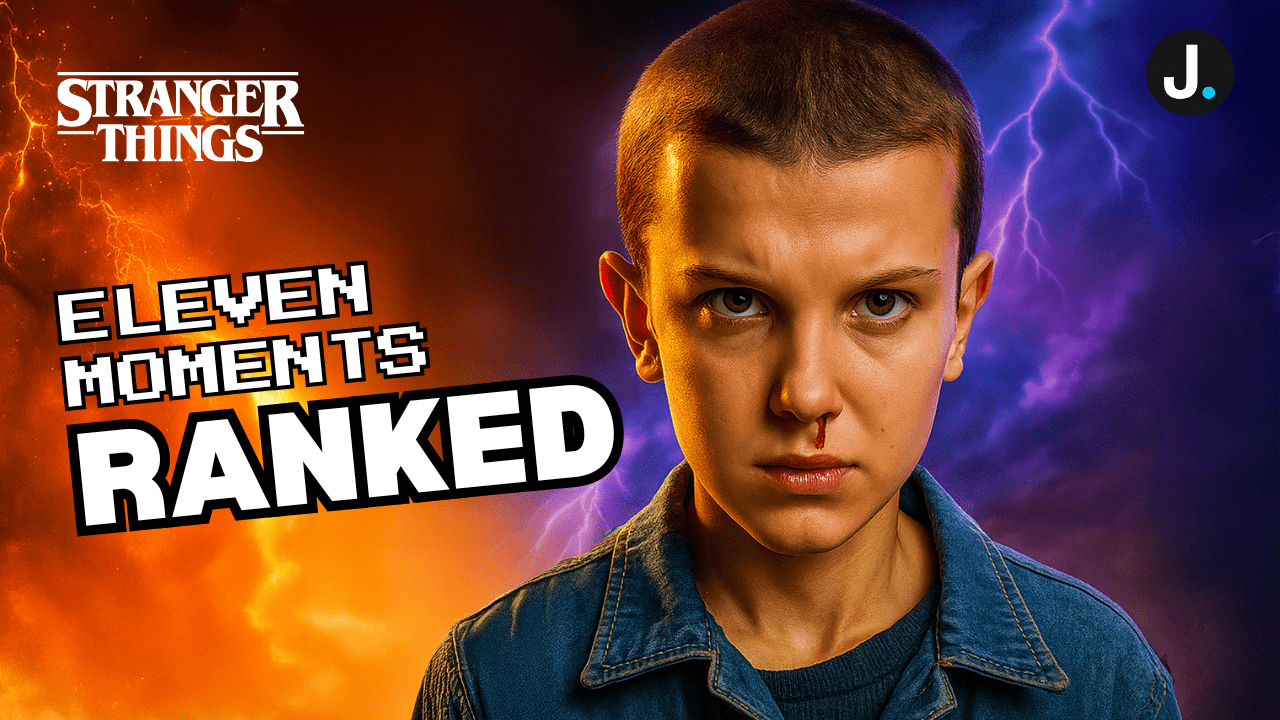
Eleven from Stranger Things is one of the most significant characters in contemporary television. She is not a conventional superhero and does not rely on gadgets or traditional powers. Instead, her abilities are the result of government experimentation, giving her telekinesis and psychic perception. Her appearance, including a shaved head and hospital clothing, immediately signals her origin and sets her apart from other characters.
Since the series debuted in 2016, Millie Bobby Brown’s portrayal of Eleven has been central to the show. The character combines vulnerability with extraordinary abilities and her story focuses on the consequences of unethical scientific experimentation. The Duffer Brothers have designed Eleven’s narrative to reflect both 1980s science fiction influences and the moral questions inherent in experimental research. Her origin highlights the risks of using children as instruments of government programs.
Eleven’s story shows clear influences from Stephen King, particularly his works featuring children with extraordinary abilities subjected to adult control. Characters such as Charlie McGee in Firestarter and Carrie White in Carrie share traits with Eleven, including isolation and the use of their powers in response to manipulation and abuse. Hawkins Lab, where Eleven is confined and trained, illustrates the consequences of unchecked authority. Dr. Martin Brenner, the head scientist, treats her as a tool rather than a person, exemplifying the ethical issues associated with experimentation on vulnerable populations.
Eleven’s narrative explores the impact of trauma and the psychological consequences of her upbringing. Her relationship with her mother, Terry Ives, who was also a subject of experiments, highlights generational trauma caused by unethical government programs. Their separation and eventual reunion illustrate the long-term effects of exploitation and the challenges of recovery.
Throughout the series, Eleven confronts not only supernatural threats but also moral dilemmas related to her powers. She uses telekinesis, telepathy, and interdimensional projection to protect her friends, and her actions often carry significant consequences. The show examines her decision-making, emphasizing the ethical responsibility that accompanies power. Unlike traditional superheroes, Eleven’s development emphasizes survival, adaptation, and moral reflection rather than conventional heroics.
Eleven’s growth is also represented visually. The design of Hawkins Lab, the contrast with domestic spaces like the Byers home, and the presentation of the Upside Down all reflect her psychological and emotional journey. Her experiences force her to reconcile her abilities with her identity, as well as the harm caused by the adults who created her.
By the fourth season, Eleven’s confrontation with Vecna represents both a literal and symbolic reckoning with her past. The narrative demonstrates her agency and the way she reclaims control over her life. This progression highlights the series’ ongoing focus on trauma, ethical use of power, and personal responsibility.
The upcoming fifth season is expected to conclude her arc. Questions remain about whether she will achieve closure, reconcile her powers with her humanity, or face further sacrifice. Eleven’s story is defined not by spectacle but by her responses to abuse, her resilience, and her ability to make ethical choices under extreme circumstances.
Overall, Eleven serves as an example of a contemporary superhero whose origin and development are grounded in realistic psychological and ethical considerations. The series uses her character to explore the implications of experimentation, trauma, and moral responsibility, providing a complex perspective on the consequences of power and control. Her journey demonstrates that resilience and agency are central to character development in modern science fiction and horror narratives.