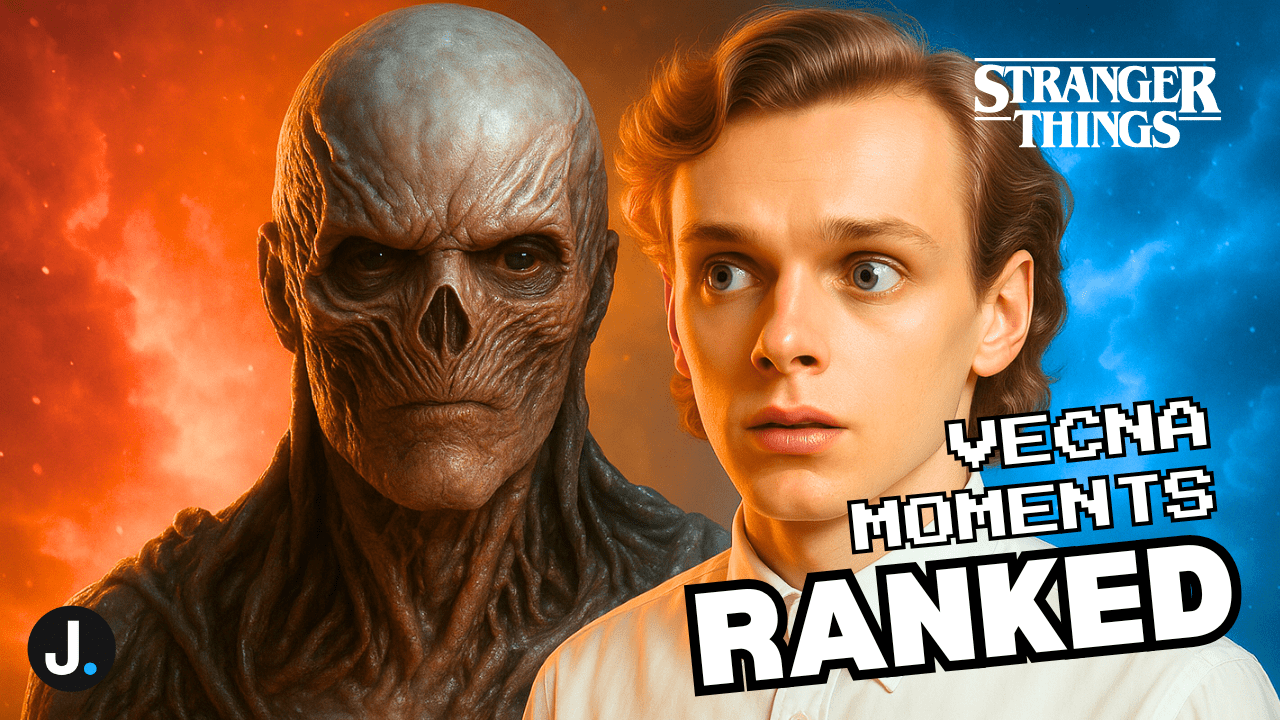
Season 4 of Stranger Things gave fans chills with the backstory of Vecna, played with haunting precision by Jamie Campbell Bower. Revealed as Dr. Brenner’s first test subject, Vecna’s transformation into a nightmarish entity was catalysed by his banishment to Dimension X, a cruel fate tied directly to Eleven’s powers. This origin story added a layer of tragic horror: Vecna was once human, subjected to experimentation and trauma, much like Eleven herself.
Trailers for Season 5 suggest that what we’ve seen so far might only be part of the story. Vecna’s new form—horned features, elongated fingers, and a presence that seems almost otherworldly—bears a striking resemblance to Asmodeus, the Dungeons & Dragons demon lord and ruler of the Nine Hells. Given that the Duffer Brothers have long drawn inspiration from Dungeons & Dragons to shape both the narrative and villains of each season, the possibility that Vecna could be an avatar or extension of Asmodeus adds a tantalising layer to the mythology.
Vecna has been portrayed as a master manipulator, psychically linking with victims and orchestrating horrors from afar. If Asmodeus is involved, Vecna may be revealed as merely the tip of the iceberg—a pawn in a game that spans dimensions and tests the very limits of Eleven’s powers and the children’s courage. This possibility raises the stakes considerably: Hawkins might be facing not only a monster but an intelligence that is centuries, perhaps millennia, ahead in its cruelty and cunning.
If any character embodies the bridge between Hawkins and the dark forces of the Upside Down, it is Will Byers. From his kidnapping in Season 1 to his possession by the Mind Flayer in Season 2, Will’s life has been inseparably tied to the supernatural. Season 4 reinforced this, with his artwork depicting a three-headed dragon reminiscent of Asmodeus, hinting at his central role in the upcoming narrative.
Will’s history of trauma and psychic sensitivity positions him as a potential vessel—or perhaps a pawn—in the confrontation with whatever greater evil lies beyond Vecna. His experiences echo those of Billy Hargrove, whose manipulation by the Mind Flayer demonstrated how vulnerable humans become when entangled with interdimensional forces. Could the final season position Will as a medium through which Asmodeus exerts influence? Or might he reclaim agency, turning his unique connection to the Upside Down into a weapon against evil?
Narratively, Will functions as more than a side character; he is a symbolic bridge between innocence and the horrifying unknown. His previous encounters with interdimensional entities give him insight that no other character possesses, making his choices crucial to the fate of Hawkins. The thematic resonance is clear: in a series that has always juxtaposed childhood wonder with cosmic terror, Will stands at the heart of that tension. His psychic link and his artwork suggest that his role in the final showdown could be pivotal, echoing the larger motifs of fate, control, and moral choice.
As the November premiere of Stranger Things 5 approaches, fans are left grappling with questions that go beyond jump scares and Upside Down creatures. Is Vecna truly the ultimate villain, or is he a harbinger for something even darker, perhaps inspired by the demonic Asmodeus? The trailers hint at escalating stakes, with the potential for the Upside Down to merge with the real world, signalling that the final conflict may be apocalyptic in scale.
The beauty of Stranger Things has always lain in its blend of childhood innocence and supernatural menace. By introducing layers of villainy and potential puppet masters, the Duffer Brothers ensure that Season 5 is not just a battle between good and evil but also a meditation on control, trauma, and moral choice. Fans have long debated the metaphysical mechanics of Hawkins: how much of what they see is driven by conscious intelligence, and how much is the unpredictable chaos of the Upside Down itself? Vecna and Asmodeus, with Will’s psychic tether woven into the mix, promise answers while maintaining tension.
The narrative possibilities are endless. Vecna could fall, revealing Asmodeus as the true adversary; Will could be corrupted, becoming a tragic “Big Bad” of his own; or Hawkins could unite in a final stand that tests friendship, loyalty, and courage like never before. The interplay of these elements reflects the series’ mastery of suspense, keeping audiences guessing while honouring the legacy of horror, science fiction, and childhood adventure that has defined the show since its inception.
Stranger Things has always thrived on mystery, the tension between innocence and the unknowable, and the emotional stakes that elevate its supernatural storytelling. With Season 5, the journey promises to push these elements to their absolute limit, challenging viewers to confront questions that linger beyond Hawkins: who truly holds power in this universe, and can humanity endure when faced with forces beyond comprehension?
As fans ready themselves for the final episodes, speculation continues to mount. Vecna may terrify, Asmodeus may manipulate, and Will Byers may face his greatest challenge yet. The stage is set for a conclusion that promises thrills, heartbreak, and revelations that will echo through the Upside Down and beyond. For nine years, Hawkins has captivated our imagination; this season, it may finally redefine what fear, heroism, and the unknown mean in the world of Stranger Things.