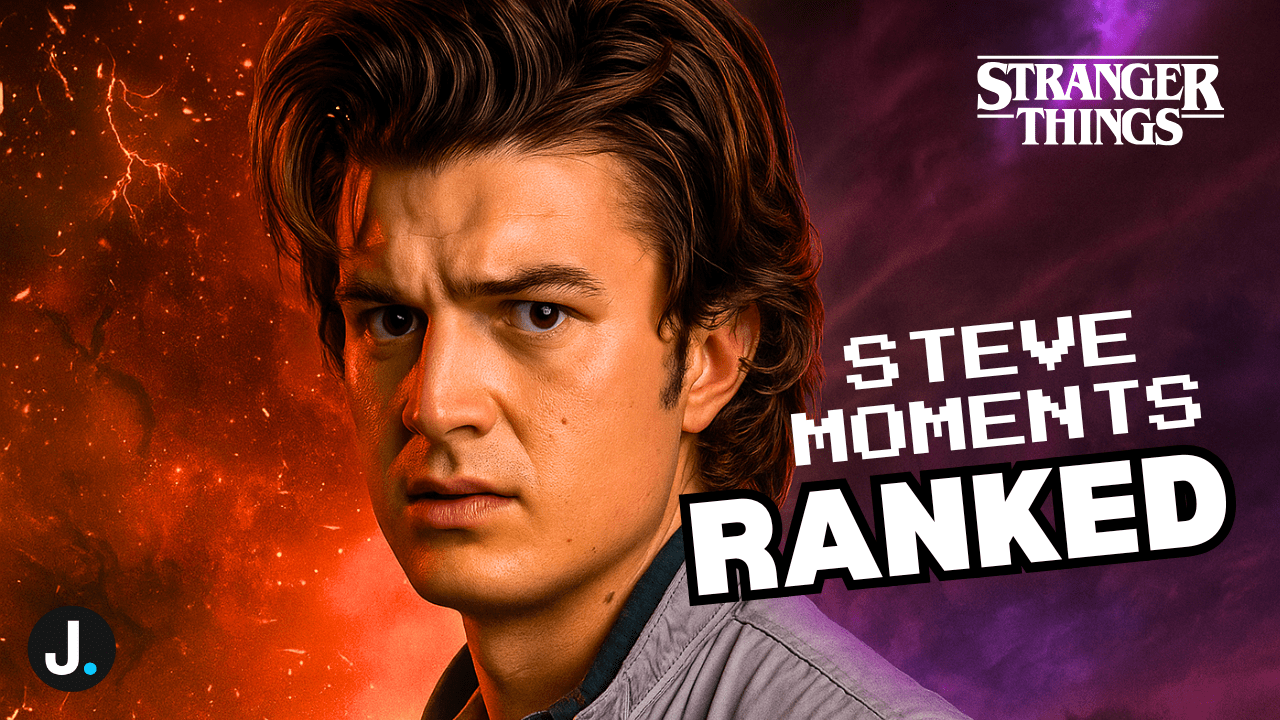
Steve Harrington enters Hawkins High School in Season 1 like a walking stereotype: luscious hair, perfect smile, and the swagger of someone who could easily be voted prom king—probably by default. He’s the epitome of the 1980s high school heartthrob, the kind that movies from John Hughes to Fast Times at Ridgemont High immortalized. But as any true fan knows, Stranger Things has a habit of twisting archetypes, and Steve’s story arc is the crown jewel of these subversions.
From the get-go, the Duffer Brothers let us peek behind the glossy exterior. Steve’s initial focus on Nancy Wheeler, his girlfriend at the time, and his insecurities about popularity hint that there’s more lurking beneath the surface. Then, fast forward to Season 2, and suddenly he’s wielding a baseball bat with nails like a suburban warrior, protecting Dustin and the younger gang from the horrors of the Upside Down. It’s at this moment that the nickname “King Steve” feels less like a playful joke and more like an earned title.
“King Steve” reflects not only his high school social status but his role as an unlikely hero—a protector, mentor, and, in many ways, the moral compass for the younger characters. Fans embraced this evolution immediately. Social media exploded with memes of Steve wielding his bat, babysitting Dustin, and providing comic relief, cementing his role as the de facto guardian of Hawkins’ most vulnerable. He’s a monarch of sorts, reigning over the hallways and byways of the town, but his authority is defined by courage and loyalty rather than locker combinations and cafeteria clout.
Joe Keery’s performance amplifies this metamorphosis. His ability to pivot from self-absorbed teen to empathetic ally is seamless, making Steve’s growth feel earned rather than contrived. In interviews, Keery has described his character as “someone who finds purpose in unexpected places,” which perfectly encapsulates why “King Steve” resonates with fans. The crown isn’t shiny or superficial; it’s metaphorical, representing the respect and affection he earns through action and heart.
The Duffer Brothers have frequently cited Stephen King as a foundational influence in crafting Stranger Things, and “King Steve” is a playful, yet pointed, homage to the master of horror himself. King’s novels often feature ordinary people thrust into extraordinary circumstances, and characters who evolve through fear, trauma, and adversity—a template that Steve Harrington embodies in real time.
It’s impossible to ignore the parallels. King’s teenage protagonists often navigate complex social hierarchies, encounter supernatural threats, and ultimately discover inner strength. Steve’s initial jock persona mirrors the “typical teen” archetype found in King’s early works, like Carrie or It, yet he diverges by developing into a character whose heroism is defined by empathy and relational intelligence rather than sheer survival instinct.
The nickname “King Steve” is therefore layered. On one level, it nods to his social hierarchy at Hawkins High, but on a deeper level, it signals the Duffer Brothers’ acknowledgment of their creative lineage. Stephen King dominated horror and coming-of-age narratives, and Steve Harrington, in his charm, bravery, and occasional clumsiness, carries a bit of that Kingian DNA into the world of Hawkins.
Fans have noticed this subtle literary nod and have embraced it enthusiastically. Online discussions dissect how Steve embodies King’s archetypes: the reluctant hero, the flawed protector, the teen who grows through crisis. Even the comedy woven into Steve’s interactions with Dustin and the gang reflects King’s balance of tension and levity. Horror is frightening, but human connection tempers it, and Steve’s evolution illustrates this beautifully.
Through this lens, Steve Harrington becomes more than a character—he’s a bridge between nostalgic 1980s high school storytelling and modern horror homage. The Duffer Brothers manage to honor King while simultaneously carving out their own narrative space, and “King Steve” is the emblem of that successful synthesis.
Steve’s transformation continues to captivate fans because it mirrors the central narrative arc of Stranger Things: growth through adversity. When Season 5 arrives, viewers can anticipate seeing this evolution take another step, as Hawkins faces new challenges and the Upside Down threatens to spill further into the real world. “King Steve” is no longer a high school archetype but a seasoned veteran of supernatural warfare, a mentor to the new generation, and a symbol of courage tempered by compassion.
The transition from self-absorbed teen to heroic ally is remarkable because it’s gradual and believable. We see him make mistakes, stumble through awkward moments, and struggle with self-doubt. Yet these imperfections only enhance his heroism. Steve’s arc reflects universal themes: learning responsibility, embracing vulnerability, and prioritizing the welfare of others. The Duffer Brothers excel at letting this growth feel earned, weaving subtle cues and consistent character beats across multiple seasons.
The humor inherent in Steve’s interactions also plays a crucial role. His sarcastic quips, awkward flattery, and occasional self-awareness provide levity in a world fraught with existential threats. But these moments do more than entertain—they humanize him, reinforcing why fans feel such a strong attachment to “King Steve.” In the chaos of battling Demogorgons, Mind Flayers, and interdimensional crises, Steve remains grounded, relatable, and fiercely loyal.
Even his physical appearance has become iconic. The perfectly coiffed hair, now seemingly impervious to wind or battle, is a visual joke that fans love, but it’s also a nod to his continuity. Through hairstyle, wardrobe, and mannerisms, Joe Keery embodies both nostalgia and heroism, blending humor and gravitas in a way few actors manage on a weekly series.
“King Steve” is more than a nickname—it’s a badge of honor, a symbol of narrative redemption, and a fan-celebrated acknowledgment of the layers that make him resonate so deeply. As Hawkins prepares for its final showdown in Season 5, Steve’s arc will remind us why transformation, courage, and heart are the hallmarks of a truly memorable character.
Fans have fully embraced “King Steve,” elevating him to meme-worthy, internet-legend status. From GIFs of him wielding his bat to fan art depicting him in heroic, almost regal poses, the affection is palpable. The nickname has even transcended the show, appearing in merchandise, cosplay, and fan conventions. He is, in many ways, a cultural touchstone, emblematic of what makes Stranger Things unique: the blend of nostalgia, suspense, humor, and layered characterization.
The affectionate moniker also highlights one of the show’s genius moves: subverting expectations. The popular kid who could have remained a shallow stereotype instead becomes a hero defined by his empathy, humor, and courage. Fans cheer for Steve not because he is perfect, but because he is real, flawed, and relentlessly human.
Even outside the narrative, Joe Keery’s portrayal has helped solidify Steve as a character worthy of the “King” title. His charisma, comedic timing, and subtle expressions all contribute to a character who is multidimensional, memorable, and beloved across generations. It’s rare for a supporting character to achieve this level of adoration, but Steve Harrington proves that charm, heart, and heroism are a winning combination.
As Stranger Things 5 nears its November 2025 premiere, the legacy of “King Steve” remains intact. The evolution from high school jock to beloved protector is complete, yet fans can anticipate new dimensions of his character as the series concludes. His nickname is more than a joke—it’s an acknowledgment of bravery, growth, and the clever intertextual nods that enrich the show. In the halls of Hawkins High and the hearts of viewers everywhere, Steve Harrington reigns supreme.